Showing posts with label tunic. Show all posts

Monday, 16 March 2015

the Thobe

OIMPalcost2.jpg

"OIMPalcost2" by Trjames - Own work. Licensed under CC BY-SA 3.0 via Wikimedia Commons.
this is the design of one of the oldest designs for the Bedouin Thobe or dress, its proportions are huge, but the Bedouin women would fold and hitch it to brooches or tie and overlap it in such a way that it would be practical and worn for everyday work in the fields or herding sheep.The folds are usually used as pockets.

Thursday, 5 March 2015

the story of the Egyptian dress


Tarkhan complete sheet First Dynasty (about 3000 BC) UC 28670
image
This ‘rectangle’ (Egyptian ifd, often translated as ‘sheet’) represents the basic item of Egyptian dress. This very early example, measuring c.283 x 105 cm and of good quality, no doubt would have belonged to a wealthy person. Before being put on it would have been folded end-to-end, creating a central transverse fold. If, rather than being used as a simple cloak, it was worn by a man in the manner of a kilt, it may also have been folded side-to-side, making a longitudinal fold. Worn thus it would have been tied on itself at the waist, with the fringed edge uppermost; the central transverse fold was at the front, reaching from the front of the waist down to the right shin. A belt or sash may have been worn over.
image
An even longer version, up to 20 m, and attested by surviving examples dating from the late Old Kingdom through to the early 18th Dynasty, must have been folded into additional layers before draping. By the 18th Dynasty, tied versions of this garment are shown being worn by women, but arranged so as to cover the upper arms and breasts as well as the lower torso and legs. The ifd survived into the Ptolemaic and Roman periods - it was known in Greek as ‘othonion’ and the later woman’s method of draping is represented in good detail on Roman-period Isis statues.
Deshasheh dresses Fifth Dynasty (about 2400 BC) UC 31182 and 31183
image
The two dresses from Deshasheh illustrate the sleeved version of the woman’s long narrow dress that was worn throughout the early dynasties, Old Kingdom and Middle Kingdom. The version more commonly shown in art (early New Kingdom example) has one or two broad straps rather than sleeves as such. The cutting diagram shows how such dresses were made from a rectangular ifd, the fringe of the ifd reappearing down one side of the dress and along one side of the V-shaped neck opening. Click on the image below, showing one of the two dresses, for a larger picture.
image
Tarkhan dress First Dynasty or Old Kingdom (about 3000-2300 BC) UC 28614Ai
imageMany of the extant early dresses are pleated and the little dress from Tarkhantomb 2050, made in the same way as those from Deshasheh, retains pleating in the upper area.
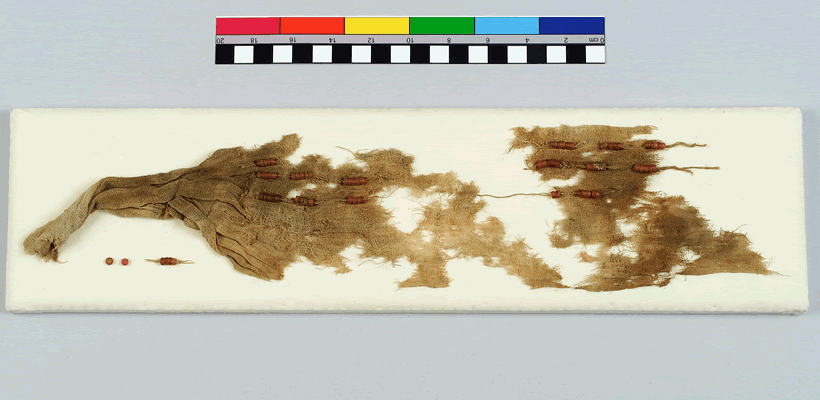
Tarkhan headband First Dynasty (about 3000 BC) UC 16355
imageAmong the mass of fragmentary clothing recovered by Flinders Petrie at Tarkhan, headbands identify themselves by their small proportions and often very fine quality. This example is not especially finely woven but is decorated with carnelian beads; it can be compared to the headband with a pattern of red flowers worn by the Princess Nefert from Meydum in the Cairo Museum. It is made from a narrow width of cloth, c.17 cm wide, gathered in at the ends by sewing. The beading suggests that is was folded on itself once more than shown here, that is giving a width of c.4 cm.
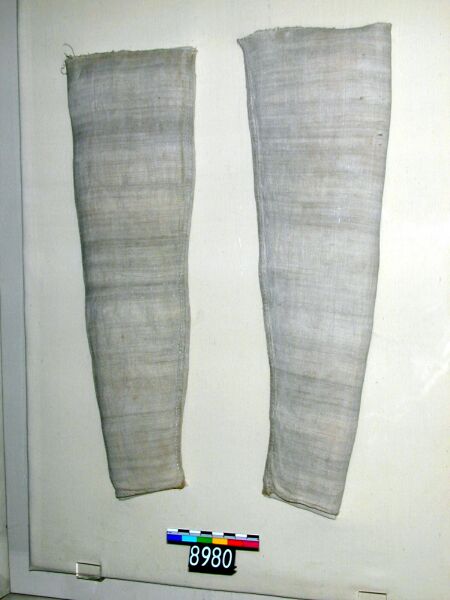
Gurob sleeves New Kingdom (about 1400 BC) UC 8980A and B
imageThe pair of sleeves from Gurob, solidly woven and neatly sewn, retain the remains of a seam at the wider end. This shows that they were once attached to tunic.
The ‘bag tunic’
A wide rectangular tunic, mss, translated by the modern term ‘bag tunic’, began to be used in Egypt in the New Kingdom. It was worn by both men and women in addition to the ifd ‘rectangle’. The great majority of surviving bag tunics are sleeveless, but plain sleeved examples were found in the tomb of the architect Kha while elaborately decorated examples in the tomb of Tutankhamun (both late 18th Dynasty).
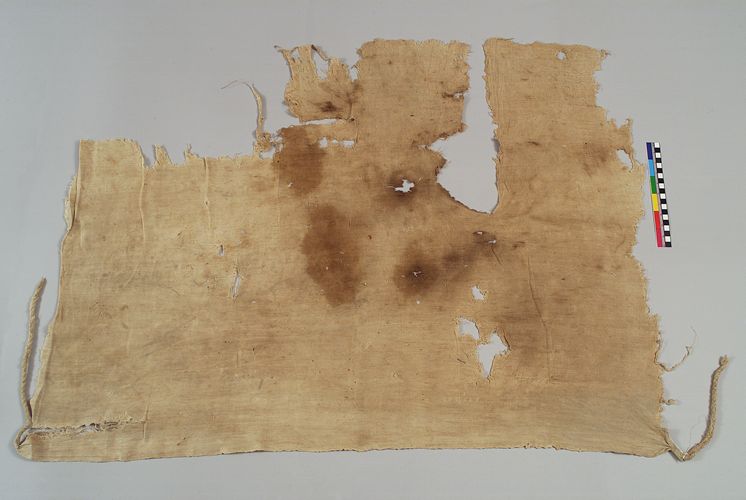
Tarkhan bag tunic Third Intermediate Period (about 800 BC) UC 28616Bviii
image
Extant New Kingdom bag tunics normally have a ‘keyhole’ shaped neck opening (a cut circle with a slit below). The very ragged bag tunic from Tarkhan, dating to the Third Intermediate Period, shows a later style of neck, a long vertical slit. The hem fringes front and back are also a later feature. This garment, very worn and extensively darned, illustrates well the typical condition of clothing found in 1st millennium burials (such semi-complete items were used for the lowest level of mummy wrapping).
image
The diagram of the Tarkhan bag tunic illustrates how the bag tunic grew out of the older ifd ‘rectangle’: the central transverse fold of the rectangle became the tunic’s shoulders, a neck hole being created through this; below the arms, the woven selvedges were seamed together.
Deshasheh kilt (Third Intermediate Period, about 800 BC?) UC 31173
imageThe one-layer garment with tying cords from Deshasheh.appears to be a purpose-made kilt. Here a rectangle of linen approximately 103 by 75 cm, although very ragged, retains parts of two original transverse edges and one longitudinal selvedge; a hem along the second longitudinal edge may represent repairs to the second selvedge. One of the tying cords is integral to the original textile and is perhaps the cord used to attach the warp to the loom before weaving (the base of the second cord has been repaired and here the original arrangement is no longer apparent).
Unprovenanced folded textile late Third Intermediate Period (about 670 BC) UC 55013
imageA narrower folded textile measuring c. 155 x 73 cm may be a man’s sash. The long inscription, parallel to the fringe, is poorly preserved but parallels indicate a date in the 670s or 660s BC.
This folded textile is a reminder that all these linen garments were stored folded up in chests. After laundering and before being put away they were folded several times down their length, as here. Wider items were additionally folded in the opposite direction. Any garment, when newly put on, would have exhibited the lines of these storage folds. Unlike pleating, however, storage folds were seldom represented in contemporary art

The Red Tunic Preservation

Height: 131 cm, Width: 209 cm including sleeves, Width: 124 cm excluding sleeves
After the Arab conquest of Egypt in 642, the long-standing traditions of Roman and Byzantine dress continued alongside Islamic fashion.
 Textiles were made for and used by the widest possible segment of the population of late Roman and Byzantine Egypt. They were made commercially in small workshops and by individual weavers. While most textile decorations were made in large numbers, many must have been individually ordered both for dress and the household.
The construction of the tunic was similar for men, women and children — one piece of cloth was folded over the shoulders and sewn together down the sides. Around the 5th century, tunics begun to be made in two or three pieces, with a horizontal seam in the centre positioned slightly above the waist. A belt, woven, braided, knitted or tablet woven, was worn to hold the folds of the garment in place. The bands and stripes that commonly decorate Coptic tunics are possibly Roman in derivation.
Curator’s Notes
(1) Two shoulder-bands, clavi, with standing haloed figures, floral devices and busts; the large pendant medallions, orbiculi, each contain a half-length figure; 
(2) two large roundels below, segmenta, and two on the shoulders, each containing a seated figure in the middle, surrounded by floral ornament partly issuing from four vases; 
(3) two large oblong panels on the sleeve, each containing a seated figure within a circle in the middle, and floral ornament and busts to the right and left. Some Greek letters. All these ornaments have borders of floral stems on a white ground, with a polychrome geometrical edging on either side. A small tapestry band, sewn across at the neck, has pairs of birds in circles. 
S-spun wool, probably Egyptian. 
The tunic is made up from several pieces: seam at the waist, and across the sleeves (the seam down centre front is secondary and probably from the time of discovery). The wrists and sides of each sleeve end in selvedges. The size of the tunic is huge with narrow sleeves. The hem is torn and raw; the side seams are turned in and stitched up (now unpicked); the sleeves are open under the armpit and the sewn tuck around waist has been unpicked. The tunic is stained and decayed in a number of places on the back and missing its two back roundels (only discolouration and stitch marks remain).
670-870 (made)
Construction 
Tunics, almost straight, shirt-like dresses, reaching to the knees or somewhat longer, appear to have been in fashion among several groups of citizens in the Roman empire from 100-1000 AD. This type of dress was also adopted by the Egyptians. The construction of the tunic was similar for men, women and children - it was made in one piece which was folded over the shoulders and was sewn together along the sides. Around the fifth century tunics begun to be made in two, or more often three, pieces with a horizontal seam in the centre positioned slightly above the waist. A belt, woven, braided, knitted or tablet woven, was worn to hold the folds of the garment in place. The bands and stripes that commonly decorate Coptic tunics are possibly Roman in derivation. Less certain is the origin of the decorated squares, circles and ovals that are an equally common features of Coptic tunic ornamentation. On tunics, the ornaments were often positioned to lie above the shoulders and in front of the knees of the wearer, vulnerable points, susceptible to disease and crippling injuries. One suggestion is that the positioning of these ornaments originated in a widespread belief that glances from the eyes of certain people could cause harm. Defenses against the evil eye are of several types: designs that are in the form of an eye, or designs of such fascination or complexity that they trap the eye, or gestures such as an upraised hand. All are found in Coptic ornamentation.
Use 
Tunics were woven from sleeve to sleeve in one piece with integral tapestry-woven ornaments (see T.7-1947), but from around the fifth century tunics were also made in two, or more often three, pieces with a horizontal seam in the centre positioned slightly above the waist, and from at least the Arab conquest (AD 639-642) there was a gradual decline in integral ornaments. This one has been made up from several pieces stitched together. All the tapestry woven decorations are applied, and on the sleeves, it is even cut and tucked into the seam, turning the straight woven sleeves of ‘Coptic’ style into shaped and narrowly fitted sleeves of the Arabic fashion.
One tunic, usually very simple, was worn as an undergarment; another, decorated with ornaments and usually wider, was worn over it. In the 3rd century the custom of burying the dead fully clothed and wrapped in multiple layers of fabrics began. Although found in graves, only a small number of tunics were actually made as funerary clothing and shrouds. Much of the clothing of the corpses was not new, and all the padding and wrapping were done with discarded and otherwise available textiles. There are also examples of tunics in graves that have never been made up, maybe suggesting a sudden death or a wish to dress the dead in new clothing, it not being deemed important to finish the garment. It is also evident that re-use was practised. A new tunic might be used as background for old, well-liked and costly decorations of which this tunic might be an example.